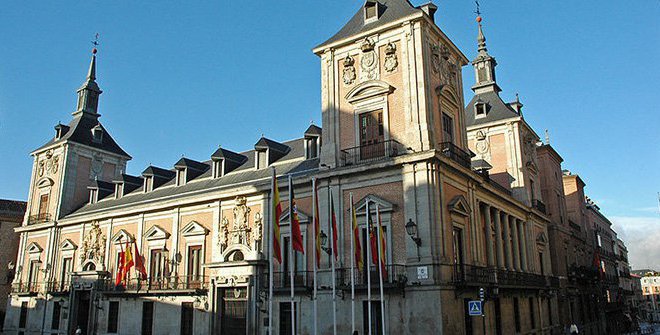
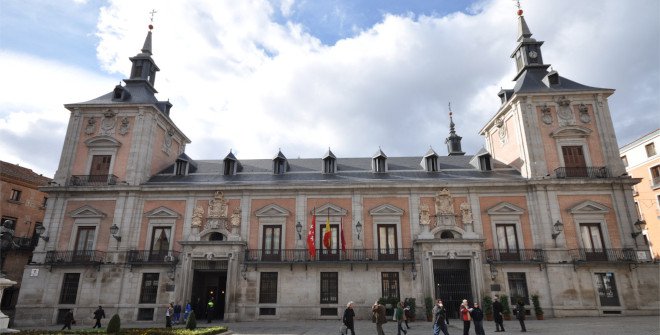
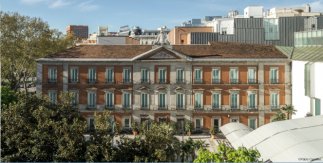
Plaza de la Villa was one of the main centres of medieval Madrid because of its location halfway between the Ports of Guadalajara and the Vega, two of the major entrances to the city during the Middle Ages. In the fifteenth century, Plaza de la Villa adopted its current name, coinciding with the granting of the title of "Noble and Loyal", received by Madrid by King Enrique IV of Spain (1425-1474).
The current building stands on the site of the former home of the Marquis of Valle, Don Juan de Acuña, where the Duke of Osuna (1574-1624) lived. It was here that he was arrested by order of the king on Maundy Thursday in 1621.
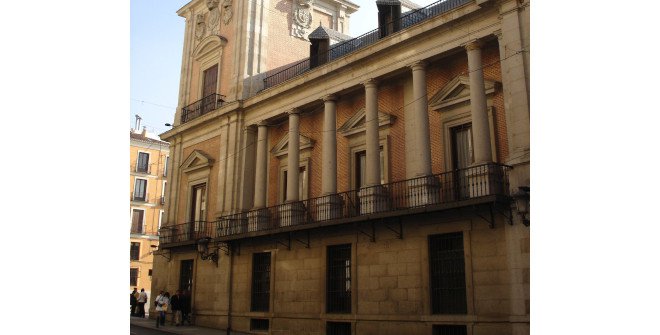
The Casa de la Villa was commissioned by King Phillip IV in 1629 to house meetings of the Council. The project was awarded to the then master builder of the Royal Works and master builder of the City of Madrid, Juan Gómez de Mora. Although construction began in 1644, it was delayed due to financial difficulties. Several architects were involved in the project over its lifetime until the building was completed in 1696 by Teodoro Ardemans, who was responsible for designing the baroque façades, the chapel, the layout of the courtyard, the grand staircase, and completing the corner towers. The gallery of Tuscan columns on the façade facing Calle Mayor is the work of Juan de Villanueva (1789).
The interior is distributed around a square courtyard, with the main living rooms located on the most important façades. Highlights include the Glass Courtyard, the Council Chamber, and the small chapel or Oratory under the old Clock Tower, topped by spires.
During the 19th and 20th centuries, it was expanded and reformed according to the needs of the City Council. Luis Bellido restored the building in 1915 and built an elevated passageway that connects it to the Casa de Cisneros.
From the date of completion of works it was the home of Madrid City Hall until, on November 5, 2007, the Mayor of Madrid moved to the Cibeles Palace, leaving this building reserved almost exclusively by the Municipal Council.
ORATORIO DE LA CASA DE LA VILLA
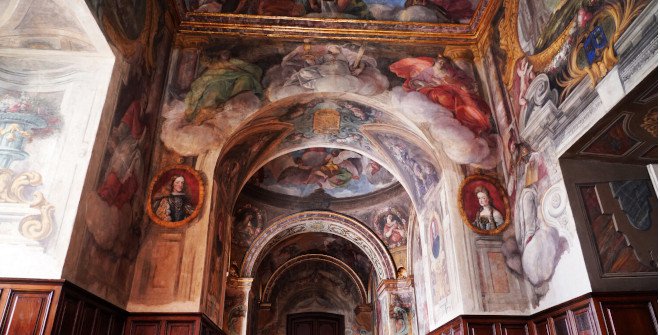
A small chapel or oratory was created within the Casa de la Villa to officiate religious ceremonies and safeguard the relics of Santa María de la Cabeza, wife of San Isidro, the city’s patron saint.
In 1696, Antonio de Palomino was commissioned to create a series of paintings focused on religious motifs that made allusions to the Monarchy and the City of Madrid, showing passages from the life of Santa María de la Cabeza and San Isidro Labrador, and other sacred subjects depicted among decorative elements. To create the paintings, Palomino used the fresco technique, influenced by Claudio Coello and Luca Giordano, resulting in one of the most unique historic works of art in Madrid.
Since the 18th century, various subsequent interventions in the oratory have caused the partial loss of the iconography and original materials.
Having been closed for decades, in 2025 extensive restoration work was carried out, allowing the oratory to regain its original character as a pictorial space from the late 17th century.

 CasadelaVilla_1398874881.865.jpg