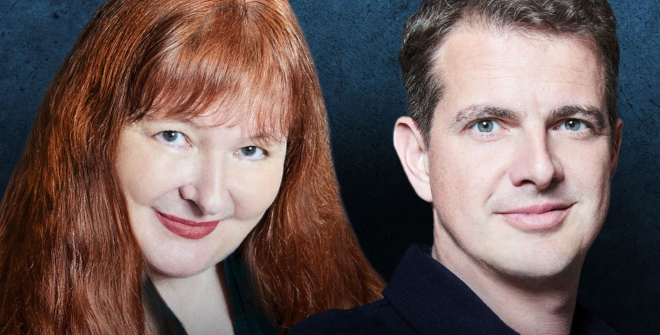
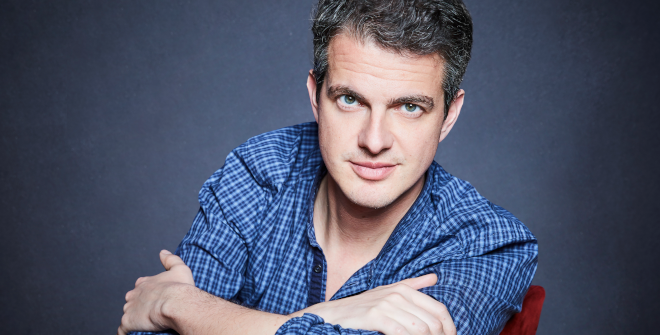
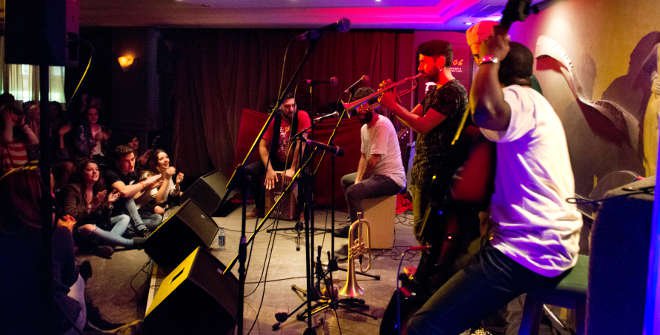
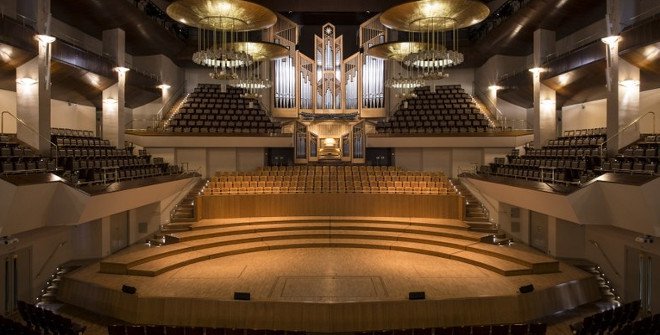
The Frontiers concert series brings together two iconic figures from historicist performance: the counter-tenor Philippe Jaroussky, one of the most admired and personal voices on today’s scene, and the charismatic Christina Pluhar, director and founder of the innovative L’Arpeggiata ensemble. Together, they will feature in the recital scheduled for 26 February in the Sala Sinfónica at the National Music Auditorium.
The musicians will present the Passacalle de la Follie programme, a fascinating journey through the vocal and instrumental repertoires of 17th-century Europe, focusing on the refined world of the salons in the French court, without forgetting Italian and Spanish influences.
With an eclectic and intriguing programme, created as a celebration of expressive freedom and Baroque fantasy, the artists will alternate between melancholic pieces, popular dances, love arias and instrumental works full of virtuosity and improvisation. Pieces by Monteverdi, Purcell, Lambert, Moulinié, Cazzati or Rossi will go hand in hand with lesser known composers, such as Boësset, Bataille or Matteis, in arrangements designed by Christina Pluhar herself.
Winner of the Victoires de la Musique for New Singer of the Year in 2004, Philippe Jaroussky has worked on an extensive solo repertoire in the field of ancient music, from the Italian 17th century to Bach, including Monteverdi, Sances, Rossi, Händel and Vivaldi. In 2017, he released The Händel Album (2017), devoted entirely to the German composer, Georg Friedrich Händel.
He has won many prestigious awards, such as the Victoires de la Musique (Best New Singer of the Year in 2004; Singer of the Year in 2007 and 2010); and Echo Klassik (Singer of the Year in Munich in 2008, with L'Arpeggiata in Dresden in 2009 and again in Berlin in 2016), among others.
Artistic File:
Venue: National Music Auditorium - Sala Sinfónica
- Counter-tenor - Philippe Jaroussky
- Musical Ensemble - L’Arpeggiata
- Theorbo and Director - Christina Pluhar
Programme:
Passacalle de la Follie
Antoine Boësset (ca. 1586-1643)
- Nos esprits libres et contents (Balet de la reyne, 1609, arr. C. Pluhar)
- À la fin de cette bergère (Airs de cour à 4 & 5 parties, livre iv, 1624, arr. C. Pluhar)
Gabriel Bataille (ca. 1574-1630)
- The Boat is on the Beach (Airs de différents auteurs mis en tablature de luth par Gabriel Bataille, livre ii, 1609, arr. C. Pluhar)
Nicola Matteis (ca. 1650-1703)
- La dia spagnola (arr. C. Pluhar, Improvisation)
Henry du Bailly (?-1637)
- Yo soy la locura (1614, arr. C. Pluhar)
Pierre Guédron (ca. 1570- ca. 1620)
- Aux plaisirs, aux délices (1614, arr. C. Pluhar)
Lorenzo Allegri (1567-1648)
- Canario (arr. C. Pluhar, Improvisation)
Étienne Moulinié (1599-1676)
- Il sort de nos corps emplumés (Concert des différents oiseaux) (Airs de cour et de differents autheurs, livre iv, 1624, arr. C. Pluhar)
- Orilla del Claro Tajo (Airs avec la tablature de luth, livre iii, 1629, arr. C. Pluhar)
- Enfin la beauté (Airs avec la tablature de luth de Estienne Moulinié, 1624)
Michel Lambert (ca. 1610-1696)
- Ma bergère est tendre et fidèle (Airs, 1639)
Giovanni Antonio Pandolfi Mealli (1624-1670)
- Sonata No. 6 in D Minor ‘La Vinciolina’, op. 4 (1660)
Claudio Monteverdi (1567-1643)
- Sì dolce è’l tormento, SV 332 (1624)
- ‘Oblivion soave’, de L’incoronazione di Poppea, SV 308 (1642)
- Ohimè, ch’io cado, SV 316 (1624, arr. C. Pluhar, Improvisation)
Maurizio Cazzati (1616-1678)
- Ciaccona (ms. Rust, arr. C. Pluhar, Improvisation)
Luigi Rossi (1598-1653)
- De Orfeo (1647)
- ‘Dormite, begl’occhi’
- ‘Lasciate, Averno’
Henry Purcell (1659-1695)
- The Curtain Tune, from The Tempest, Z 631 (1674)
- Music for a While, Z 583/2 (1692)

 cndm._philippe_jaroussky_y_larpeggiata.png