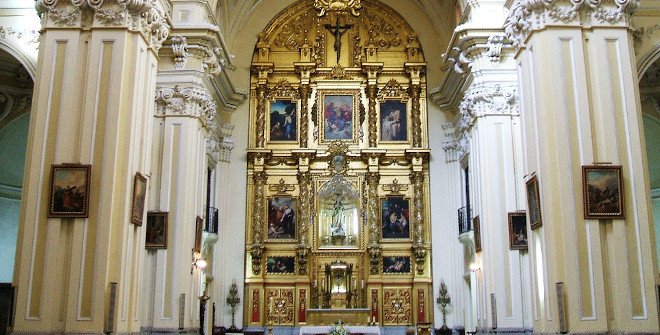
This Catholic church located between the neighbourhoods of Lavapiés and La Latina dates back to 1612, when the Oratory dedicated to San Marcos and Our Lady of the Favour was founded on Calle del Oso by Diego de Vela y Ordóñez de Villaquirán, housed in a number of residential properties he owned. Gifted to the religious order of the Theatines in 1633, this congregation founded a church in 1654 under the patronage of Saint Cajetan of Thiene, co-founder of the Theatine order, which is the origin of the church we see today.
The first plans to establish the church were commissioned to Marcos López in 1678, but very little progress was made. In 1700, José Benito Churriguera took on the project, working on the large, highly decorated façade, although most of the construction and decoration are attributed to Pedro de Ribera. Following Ribera’s death, the building was completed by Francisco Moradillo, who simplified Ribera's originality.
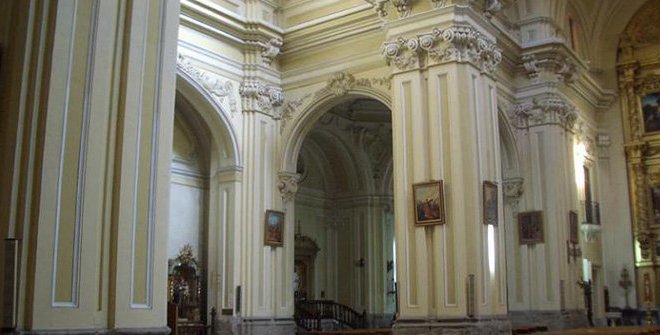
The church is based on a Greek cross design and is crowned with a large dome resting on Byzantine-style pendentives. The inside has three naves and four closed chapels with their corresponding domes.
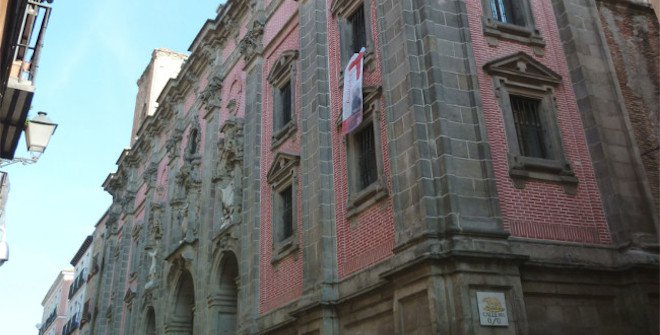
The façade was built in granite and has been attributed to Churriguera. It is made up of eight large pillars topped off with capitals of the compound type. The two pillars at each end frame the two towers and, between the four central ones, there are three semi-circular entrance arches. Above the arches, in niches, are the statues of San Cayetano, Nuestra Señora del Favor and San Andrés Avelino, made in limestone by Pedro Alonso de los Ríos.
The temple was set on fire in 1936 during the Civil War and it would have been completely destroyed if it weren’t for the falsework carried out by Fernando Chueca Goitia. It was rebuilt after the war; its façade was completely saved and its large central dome was rebuilt.
In 1980, it was declared a Site of Cultural Interest in the National Historic-Artistic Monument category.
The feast of San Cayetano is celebrated on 7th August every year, the first of the three most important religious celebrations held in Madrid during the month of August, together with San Lorenzo and La Paloma. To mark this event, the parish officiates a procession in which there is a centuries-old tradition according to which, if you pray to San Cayetano on the day of his feast, take a flower from his chariot, and accompany him during the parade, the saint will hear your plea.

 san_cayetano.jpg