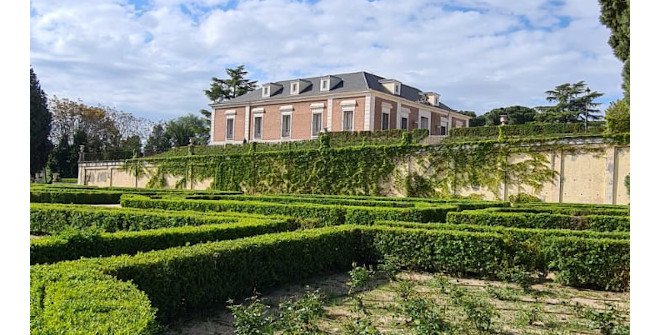
El Pardo Royal Site is home to this estate, declared a National Monument in 1935 and which stands out for its beautiful French-style gardens, designed in the 18th century by Claude Truchet, and its small palace, which is similar to Zarzuela Palace.
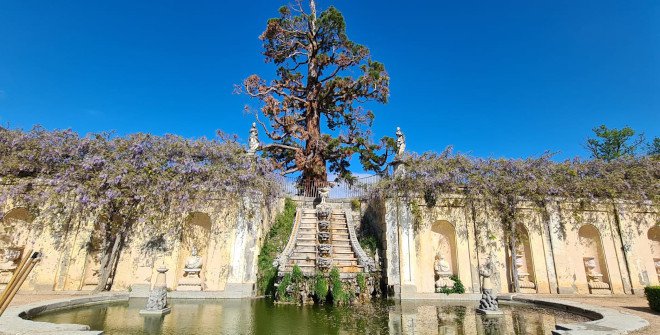
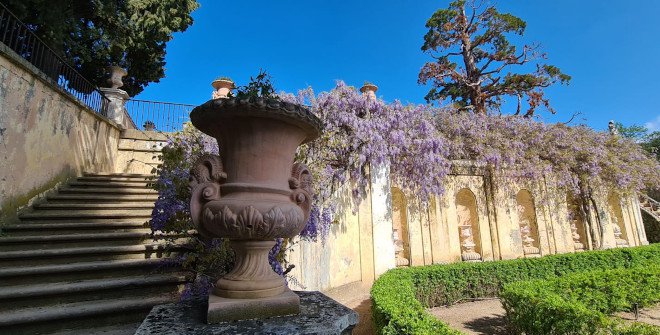
The design of its French-style Baroque garden incorporates Spanish and Italian elements. There are terraces, various sculptures, ponds, a waterfall and large conifer trees, which are reminiscent of the royal gardens at the Granja de San Ildefonso. Inside, there are also two examples of redwood trees.
The estate was initially called Quinta de Valrodrigo. In 1717, it was acquired by the Duke of Arco, Alonso Manrique de Lara y Silva, the King’s Great Equerry. Following his death, his widow passed the estate over to Felipe V and Isabel de Farnesio, who incorporated it into the El Pardo Royal Site.
The estate has had various uses over the years. During the Second Republic, it was the residence of Manuel Azaña, President of the Second Republic. During the civil war, the palace was severely damaged and was later reconstructed between 1940 and 1941. It was opened in October 1942 by Francisco Franco as Isabel the Catholic Command Academy, an instructor academy for the
Women’s Section.
Today, the palace is rented by National Heritage to hold events, so it is not open to the public, although its gardens may be visited free of charge.
As an interesting fact, the estate has been used to film “La Cocinera de Castamar” and “Lo Que Escondían Sus Ojos” series.
---------------------------
Images: © National Heritage