Pinar del Rey in the Hortaleza district is home to Huerta de la Salud Park, whose origins date back to the 18th century when it was a large orchard and farmhouse, known as the Quinta del Cristo de la Salud, built by the Dukes of Frías and rebuilt at the end of the 19th century as an agricultural and livestock farm.
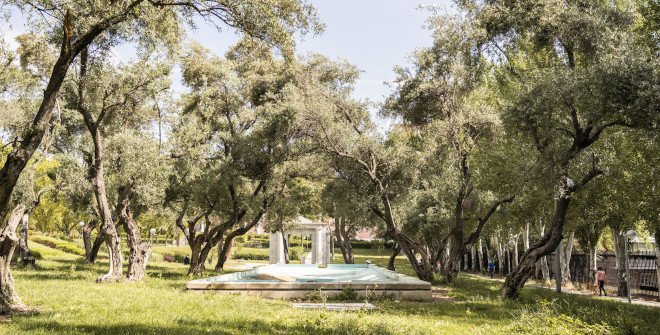
Hortaleza, whose earliest references date back to 1361, was probably founded around the 13th century. Initially, it was an area with a large number of orchards, where typical Mediterranean vegetables were grown, along with vines, wheat and olive trees.
In 1894, the Quinta del Cristo de la Salud, owned by the Dukes of Frías, was acquired by Pedro Tovar, a notary, lawyer and councillor of Madrid City Council, who converted it into an agricultural farm called Huerta de la Salud, due to the increased demand for vegetables and agricultural products in Madrid.
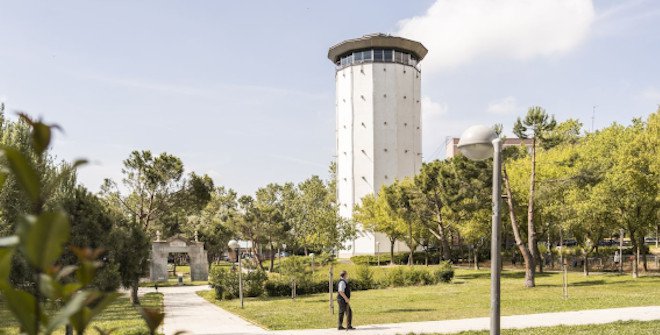
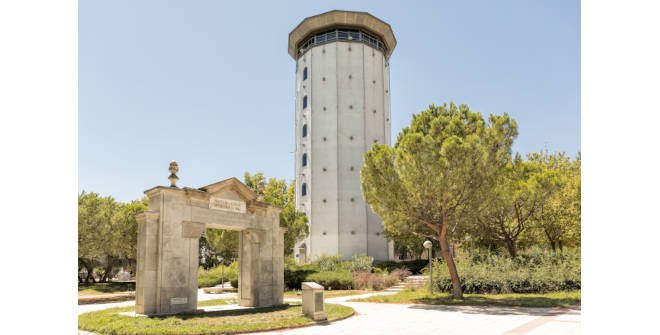
In 1928, several buildings were constructed, including a silo, which was used to store grain and was one of the first reinforced concrete structures in Madrid and in the whole of Spain.
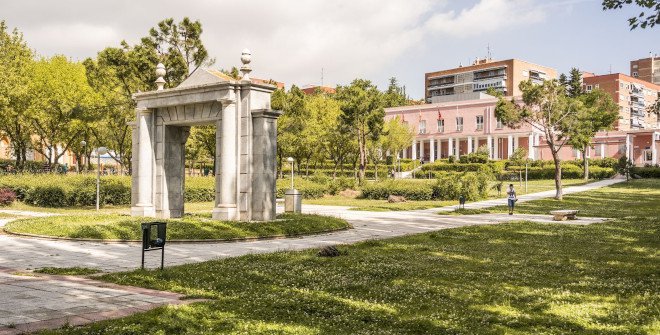
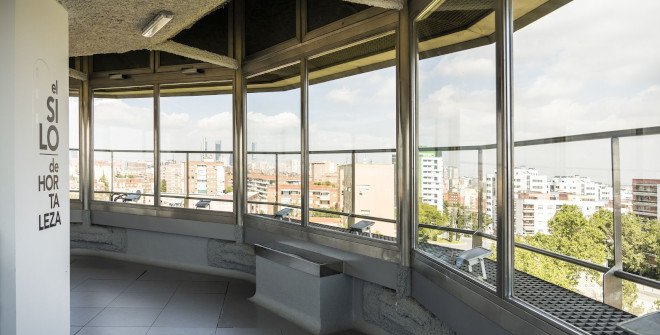
In the last quarter of the 20th century, almost all the buildings were demolished and Huerta de la Salud Park was built on this site, which includes several blocks of apartments and public facilities, such as a cultural centre and a library. The silo, which is now a space for exhibitions and cultural events managed by the Huerta de la Salud Cultural Centre, and the Huerta de la Salud Gate are the only buildings of the agricultural farm that remain standing, both of which were restored in 2002. The silo, which is included in the Catalogue of Protected Buildings, is a 20-meter-high dodecagonal tower divided into seven floors. There is a vantage point on the top floor, offering panoramic views over Madrid.