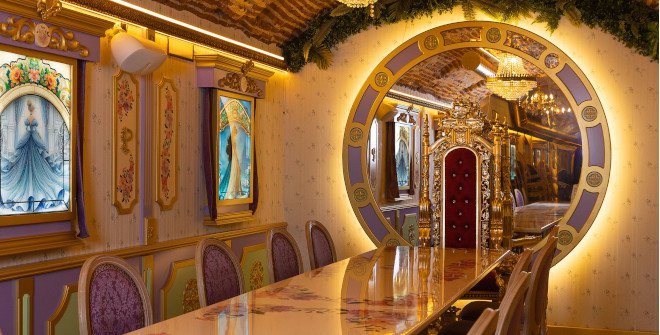
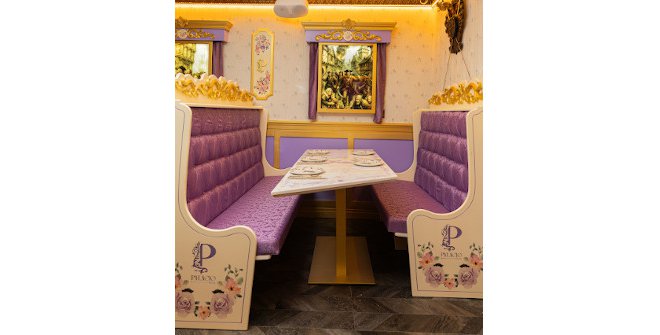
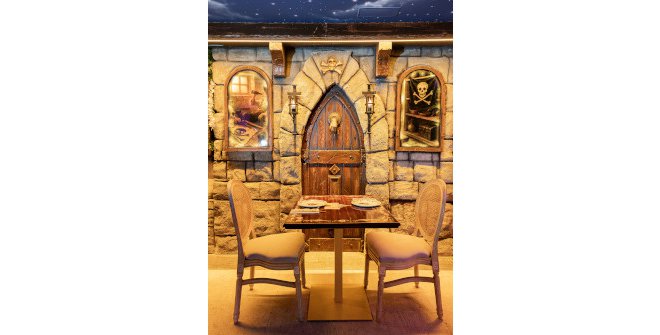
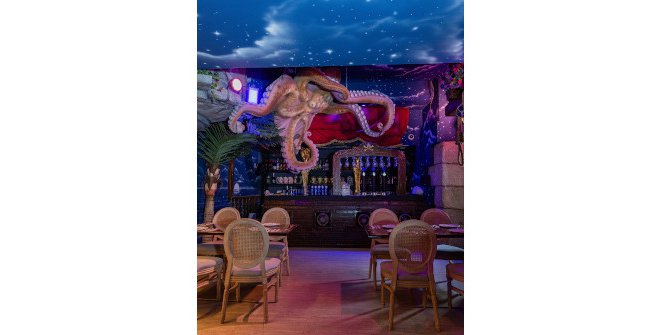
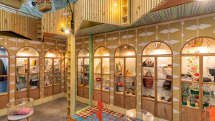
The Anglona Palace is home to the latest restaurant run by the Fantasía Group, which is behind several restaurants in Madrid (Storyland, Secretos de Lola and Santa la Vaca) where food can be savoured as if it were a fairy tale. In this latest gastronomy adventure, pirates and dragons join fairy tale princesses in a unique environment in the La Latina neighbourhood.
This innovative immersive restaurant, with seating capacity for 130 diners, tells the story of Princess Anne, Prince Thomas and Drakon the dragon, and how together they manage to save themselves from a pirate invasion. At the entrance to the restaurant, there is a large bar with a dragon on the upper part. Behind it, there are several rooms, designed to represent each scene in this epic tale, inviting diners to be part of the story, and a dressing room where they can dress up and put
on make-up.
The refurbishment of the palace was carried out by the artist José Piñero, known for his artisan style and his ability to transform spaces with unique handmade pieces. The sculptures and murals that adorn the restaurant have been created exclusively for this project, turning each corner into a work of art that reflects the spirit of the story. Piñero has succeeded in giving each detail its own personality, striking a perfect balance between the palace's noble past and the magic of the story.
Its menu consists of international dishes to share, a range of meats, pasta and original desserts, as well as a variety of cocktails. They are all presented on original dishes that leaves no one feeling indifferent.
Anglona Palace
Built in the 17th century, this historic building has been the residence of nobility and the meeting point of Madrid’s aristocracy. Its history is marked by people like Pedro de Alcántara Téllez-Girón y Pimentel, son of the 9th Duke of Osuna and 2nd Prince of Anglona, who lived in the palace during its heyday.
The palace is connected to the Palacio Real via secret tunnels that once joined the two buildings. Over the centuries, the palace has undergone numerous transformations: from its first refurbishment in 1776 to its neoclassical adaptation in the early 19th century, as well as the revamping of its gardens in 1920, which gave a more contemporary touch to its classic nature.
The Prince of Anglona Gardens are adjacent to the palace, representing a small green corner in the heart of Habsburg Madrid that can be visited from Monday to Sunday.

 palacio_by_lola_3.jpg