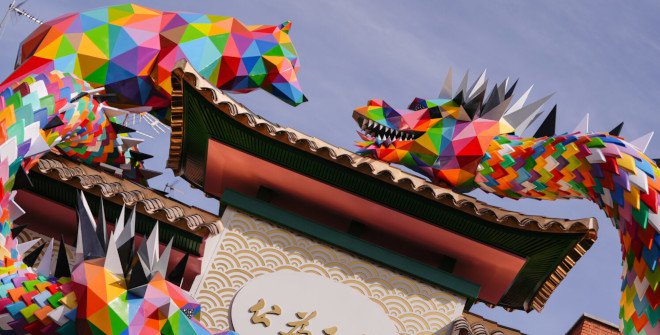
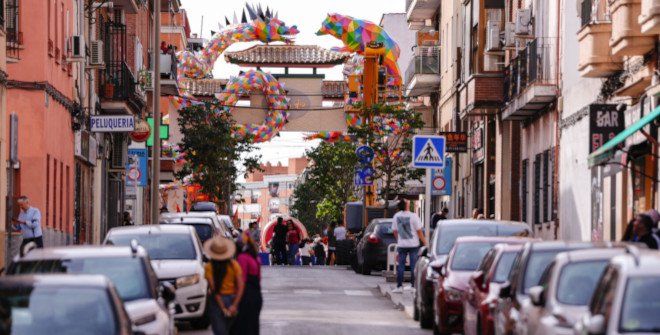
Plaza del Hidrógeno, in the district of Usera, is unveiling its new monumental decorative archway, “Two Cultures in Love” by Okuda San Miguel, one of two arches on display in Madrid’s Chinatown.
Artist Okuda San Miguel has created the capital’s first Chinese arch. A sculpture situated in the Plaza del Hidrógeno, entitled ‘Two Cultures in Love’, depicts the two symbols of the two cultures that make up the neighbourhood: the bear of Madrid and the dragons of Chinese mythology.
The decorative arch, traditionally known as paifang, is used to mark a location and pay tribute to a story. In the district of Usera, Okuda San Miguel reinterprets the structure’s original character, transforming the arch into a symbol of the identity, diversity and transformation of a neighbourhood that is growing through cultural exchange.
The structure is 11 metres long and 12 metres wide, and has an internal span of 8 metres. The portico is made of white concrete with a metal roof and features three figures – a bear and two dragons – which symbolise the twinning of Madrid’s traditions and Chinese culture.
Meaning of the inscriptions on the arch
On each side of the Chinese arch in Usera, designed by artist Okuda San Miguel, there are also messages written in Chinese calligraphy that speak of coexistence, respect and harmony. Each side features three messages: one in the centre and one on each column.
On the front, the message on the central panel is ‘The world belongs to everyone’, an idea that champions the common good and social justice over individual interests. On the left-hand column, the message reads ‘Affection and respect bring friends and neighbours together’, and on the right-hand column, ‘Harmonious relations between China and the world’. On the side panels, a character meaning ‘blessing’ is repeated several times.
On the back of the arch (as seen from Calle de Marcelo Usera looking towards the Plaza del Hidrógeno), the central sign bears the Confucian saying ‘Harmony is invaluable’. On the left-hand column: ‘Great wisdom unites East and West’ and, on the right, the Taoist proverb ‘The highest goodness is like water’, which teaches that true virtue is humble, flexible and benefits everyone without seeking conflict, just like water.
The project is the result of a collaborative partnership between Usera District Council, the artist and the Chinese community, which also contributed to the design.
Madrid’s Chinatown
Since 2022, Madrid City Council has been working with Usera District Council and the Department of Tourism on a project to transform an area of the Usera district into Madrid’s new Chinatown.
One the first initiatives carried out is the installation of a panda sculpture donated by the Chinese community, between Calle de la Pilarica and Calle Julio Merino; along with the pedestrianisation of Calle de Dolores Barranco, which has been transformed into a new route connecting the heart of the neighbourhood with Madrid Río and is full of references to Chinese culture.
Furthermore, to mark the entrance and exit of this area, two decorative arches have been designed: one situated at the junction of Calle del Olvido and Calle Dolores Barranco, and this one, designed by Okuda and situated in the Plaza del Hidrógeno, which was unveiled on 1 October 2026.