Home to the Kings of Spain from Carlos III all the way through to Alfonso XIII, Madrid´s Royal Palace is now open to anyone who wants to take a trip through Spanish history. Visitors can wander through the many rooms, enjoying the beautiful architecture and the art collection still housed here. Though it is no longer the current royal family´s home, it is still their official residence and the place where public acts and official ceremonies are held. Furthermore, the spectacular Changing of the Royal Guard takes places there every Wednesday.
Long before Madrid was the capital of Spain, Emir Mohamed I chose the village of Magerit as the site for a fortress to protect Toledo from the advancing Christians. The building was eventually used by the Kings of Castille until finally becoming what would be known as the Antiguo Alcázar (Old Fortress) in the 14th century. Carlos I and his son, Felipe II, were the main inspiration for its transformation, turning the building into a permanent home for the Spanish royal family. However, in 1734 a fire burnt the Palace of the Austrias to the ground, and Felipe V ordered a new building to be constructed in its place.
Following the untimely death of Filippo Juvara, the architect originally commissioned to design the palace, it was his pupil Juan Bautista Sachetti who eventually drew up the final plans. Seventeen years passed between the laying of the first stone in 1738 and final completion of the work commissioned by Felipe V. However, it was Carlos III (known as the "Mayor of Madrid " due to the large number of reforms and initiatives that he was responsible for in the city) who ended up being the first monarch to occupy the new building. He also commissioned Sabatini to complete its decoration, overseeing the final work at the Palace of the Bourbons. His successors, Carlos IV (responsible for the creation of the Hall of Mirrors) and Fernando VII, added many decorative details and furnishings, such as clocks, items of furniture and chandeliers.
During the 19th century, elements were installed that were notable for their modernity and that led to a certain degree of decorative refurbishment. Painted wallpaper was put up, which meant that some paintings had to be removed from the palace walls and given to the Prado Museum. The last of the monarchs to use the building as a regular home was Alfonso XIII and his wife Victoria Eugenia.
The palace, inspired by sketches made by Bernini for the construction of the Louvre in Paris, is built in the form of a square and looks out over a large courtyard with galleries and a parade ground. The living quarters are distributed over six floors, and only the most important rooms look out from the external façades.
The main entrance to the palace is built into the façade that overlooks the Plaza de Armas, a huge esplanade which, though walled, is directly connected with the entrance to the Almudena Cathedral. This is a perfect setting for military parades by the Royal Guard or the Army, and the king often inspects the troops here. The western edge opens onto the gardens of the Campo del Moro, while to the east the building looks out over the Plaza de Oriente.
Solemn and grandiose, the palace’s exterior architecture boasts columns, cornices and mouldings, all topped with a decorative balustrade. Some of the many windows that look out of the building’s different façades have balconies to indicate important rooms. Thus, the Throne Room is clearly identified on the main façade, framed as it is with four impressive columns. On the west façade, a balcony shows the position of the Comedor de Gala (Banqueting Hall), while the Comedor de Diario (Daily Dining Room) looks out onto the Plaza de Oriente. The north face of the building is formed by the chapel and therefore has no balconies.
The decoration of the palace’s rooms and their layout has gradually changed over the years as the building has been adapted to suit the needs of its residents. Each of the monarchs has left their own personal stamp on the building, creating their own individual spaces at the palace. One room that is worthy of particular mention, both for its significance and for its richness, is the Throne Room, an elongated space whose walls are covered in red velvet and silver thread. Furnished with mirrors made at La Granja, console tables and clocks, and dominated by the Tiepolo fresco that decorates the ceiling, this room is used for the most important ceremonial occasions.
Another of the palace’s most outstanding rooms is the Salón de las Columnas (Column Room), where Spain signed the Treaty of Accession to the European Union. With a vaulted ceiling painted by Giaquinto, the walls are covered in 17th century tapestries and the room is decorated with Roman busts and statues from the Old Fortress. This was the room used for official ceremonies until Alfonso XII ordered remodelling work, during which three rooms belonging to the Queen’s Quarters were joined together and turned into what is now known as the Comedor de Gala (Banqueting Hall). Work was completed at the end of the 19th century, creating a room decorated with 16th century tapestries, Chinese porcelain vases from the 18th century and paintings by Mengs, González Velázquez and Francisco Bayeu.
Among other areas worthy of special mention is the entrance from the Plaza de Armas, through which carriages brought visitors to the foot of the main staircase. Designed by Sabatini, each step of this staircase is carved from a single block of stone, and the vaulted ceiling is decorated with a fresco painted by Verrado Giaquinto.
Other rooms include the Salón de Alabarderos (Halberdiers’ Hall), one of Carlos III’s personal rooms, the Salita Gasparini, with its grand 18th century decoration on a floral theme, the Royal Chapel, with its large dome adorned with a fresco of the Coronation of the Virgin by Cerrado Giaquinto, and the Gabinete de Maderas Finas, created by Queen María Luisa and decorated in the Rococo style.
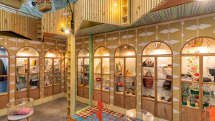
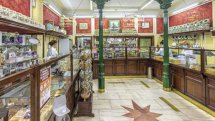
The Royal Pharmacy is a fascinating room that contains cupboards used to store medicinal plants, ceramic pots, flasks made by the La Granja factory and even prescriptions dispensed to members of the royal family, while the Royal Armoury is well worth a visit.
The Royal Armoury at the Royal Palace is considered one of the most significant collections of its kind. It houses a valuable collection of weapons and armour worn by the Kings of Spain and other members of the Royal Family since the 13th century.
After a long period of refurbishment works, it was reopened to the public in 2000 to present a large selection of weapons and armour from the Middle-Age together with Carlos V's and Felipe II's armouries.
Laid out to the west of the Palace on grounds that slope down towards the Manzanares River is the Campo del Moro, an area used for festivals and tournaments during the Middle Ages. Felipe V originally transformed the space into a hunting ground, planting trees and installing fountains, but Queen María Cristina subsequently converted it into a 19th century English-style garden with a romantic natural theme, introducing small woodlands and paths and creating the distinctive Tritones and Palacio de las Conchas fountains.
To the east, on the opposite side of the building, is the Plaza de Oriente, dominated by a statue of Felipe IV that was created by Pietro Tacca after a design by Velázquez. The square is also guarded by a series of white stone figures that were originally intended for the palace walls. Although the project dates back to the 18th century, it was during the brief reign of José Bonaparte that the buildings that originally covered this site began to be pulled down. When Fernando VII regained the throne he entrusted the work to Isidro González Velázquez, who designed an open semicircular area overlooked by the Palace façade, going on to build the Teatro Real, a portico and six blocks of houses.

Finally, opposite the north façade, in the space once occupied by the stables, Fernando García Mercadal created the Sabatini Gardens in 1930, a reference to the original plans drawn up by the 18th century architect.
The Palace is now used for award ceremonies, royal audiences and banquets and important events such as Spanish National Day, when the royal family greet important figures from Spain’s cultural, artistic and social circles, Pascua Militar (6 January), when a reception for high-ranking military officers and members of the government is held in the Throne Room, and the presentation of credentials by new foreign ambassadors arriving to take up their positions in Spain.
During 2004, the Palace was the chosen venue for the wedding of the Prince of Asturias.
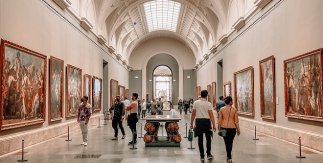
With the aim of displaying the largest possible number of artistic treasures guarded by Patrimonio Nacional (Crown Heritage), the Royal Palace in Madrid has reopened this gallery, composed of nine rooms where a total of 70 paintings can be seen. The display occupies the former quarters of the Infant Isabel (named La Chata), who lived there until 1901, and completes the tour through the Palace’s Official Rooms.
For just one euro more than the normal entrance price, up to twenty visitors can take part in a guided tour to see the evolution of movements in the painting world, from the 1600s right up to the beginning of the 20th century. The tour begins in the study, where various musical instruments can be seen, before moving on to the “Embroidery Room”, a former bedroom where a series of 18th century works can be viewed.
The first paintings can be seen in a room dedicated to Flemish painting, which houses paintings such as the Virgin with Child by Luis Morales, and the Portrait of Isabel la Católica by Juan de Flandes, who also created the Polyptych, a series of fifteen small panels belonging to Queen Isabel.
The fourth room displays 17th century Flemish painting, and on its walls hang pieces by Gérard Seghers and Jan Cossiers, who collaborated with Rubens, as well as David Teniers. The Italian School is the star of the next section, where Salome with the Head of John the Baptist by Caravaggio. Under the ceiling fresco in which Lorenzo Tiépolo depicts a Study of Birds, other works are displayed, including those from Caracci, Tempestá and Michelangelo Merisi.
17th century Spanish painting, led by Velázquez, can be found in a former bedroom in which some of the artist’s great works can be seen, such as The White Horse, Head of a Stag and the Portrait of the Count-Duke of Olivares. Antonio de Pereda and Francisco Rizzi can also be seen in this room.
Rooms 7 and 8 house works by Spanish painters from the 18th and 19th centuries, with pieces from masters such as Goya and Giaquinto. The Academy of art by Miguel Angel Houasse, and Virgin with Child by Mengs, are two of the key pieces in these rooms, which have as their star attraction Goya’s work Saint Isabel of Portugal Healing the Wounds of a Sick Woman.
The tour ends between the second half of the 19th and the start of the 20th century, in an area characterised by two great portraits of the Infant Luisa Fernanda, Duchess of Montpensier, and her husband Antonio of Orleans, painted by Federico Madrazo. Alongside these pieces is the Portrait of the Prince of Asturias, by Joaquín Sorolla, as well as landscapes by Genaro Pérez Rusiñol, amongst other works.
Sunset at The Royal Palace
The Royal Palace's Main Façade
Tourism City of Madrid | General Conditions of Use | Privacy Policy | Site map | Contact | Advertising | Accessibility
Always | What's on | esMADRIDtv | Specials | Services | Business | esmadrid4u
© E.M. Promoción Madrid, S.A. 2009. All Rights Reserved.