
Cultural institutions

museo lázaro galdiano

A journey through the history of European art

The museum boasts a stunning collection of Spanish art, which includes works by Goya, Velázquez, Hieronymus Bosch and El Greco, as well as a large assemblage of European art.

Upon his death in 1947, José Lázaro Galdiano bequeathed his assets to the State, a legacy, which the Museo Lázaro Galdiano has been exhibiting since. The artist, born in Navarra in 1862, studied law and worked as an art critic and journalist for La Vanguardia, a newspaper based in Barcelona. At the end of 1888 he moved to the capital, where he founded his own publishing house La España Moderna and started to collect art.

In 1903, he went to Rome to marry Paula Florido, a well-off Argentinean, who supported his love for art collecting, and a year later he began building the Palacio Florido, in Calle Serrano; a palace, which originally served as the family's residence in Madrid and was later turned into an exhibition space for his collections.

After his wife's death in 1932 and the outbreak of the Civil War, Lázaro Galdiano moved to Paris and then New York. There he continued building up one of the most impressive private collections in Spain, whose starting pieces were a medallion by Pisanello, made for Alfonso V of Aragon, and an Italian golden mark.

A Guide to the Collection

The tour of the museum starts on the bottom floor, which once housed the kitchens, boiler room and garages. This area offers visitors the chance to learn more about Lázaro Galdiano, who aimed to build up a collection which would serve as a reference point for valuing Spanish art and history. He was also eager to enlarge his assemblage of foreign art, thus encouraging comparisons between works from his homeland and from abroad, all of which were of the highest quality.

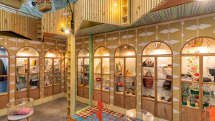
Another reason why the collector continued to purchase new pieces was the beauty he saw in the objects themselves. This is reflected in one of the museum's central rooms, which holds a collection of disparate works such as the Sword of Conde de Tendilla (1486) by Giacomo Magnolino and the portrait of Doña Ana de Austria painted by Alonso Sánchez Coello in around 1571. From here, visitors step into the treasure chamber, which houses precious metals and stones set in items of jewellery and other singular objects. It features an array of artefacts, from pieces of gold found in Visigoth excavations to jewellery crafted during the 19th century, and includes items that belonged to Paula Florido. Especially worthy of note is Emperor Rodolfo II´s chalice, made from crystal rock, gold, enamel, diamonds and rubies.

15th- and 16th- Century Spanish Art

The collection, in which paintings predominate, continues on the first floor, where a chronological selection of Spanish works is exhibited in numerous rooms of the building's public area, starting in the former room of honour, whose ceiling was painted by Eugenio Lucas Villamil.

San Diego de Alcalá. Zurbarán.This room holds 15th-century works, which Lázaro's contemporaries regarded as cheap, but for which the artist felt special predilection from an early age. Blasco de Grañén's Virgen de mosén Esperandeu (1439), the beautiful Tríptico del Nacimiento (Nativity triptych) by the Master of Ávila, and San Jerónimo en el scriptorium by Maestro de Parral, are just some of the masterpieces on display within these four walls.

Visitors then step into the music room filled with 16th-century panels, which reflect the transition of art towards the new trends of the Renaissance, with Italian and Flemish influences. Especially noteworthy are the panel paintings by Bartolomé Castro, including Santo Domingo, and others by the Master of Astorga such as Traslación del cuerpo del apóstol Santiago (Transfer of the Body of the Apostle Santiago).

In the adjoining room, visitors are met by women donning their most beautiful dresses and exquisite jewellery. Numerous portraits, including that of Catalina Micaela, Duchess of Saboya, illustrate the image of women from the 16th and 17th centuries.

Golden Age

Spain's political expansion during the 16th and 17th centuries brought about a growth in the arts, especially in painting. The room in the Florido Palace once used for gatherings now houses works by El Greco, Coello, Zurbarán and Murillo, as well as the most important pictures of the Madrid school.

Walking into the ball room, visitors will sense how the 17th century realist art, which was more befitting of the times, started displacing 16th-century idealism. The room's exhibit includes works by Felipe V's painter Miguel Jacinto Meléndez, Luis Paret´s La tienda (The Antique Store), painted in 1772 for Prince Luis, and Virgen del Pilar by Ramón Bayeu.

Goya and the 19th Century

It is widely known that Lázaro Galdiano was fascinated by Goya's works. In a little alcove, which once served as a dressing room, art enthusiasts will now find many of the artist's works which formed an essential part of his career, including: La era or El verano (Summer), La Magdalena penitente (Magdalene in Penitence), El conjuro or Las brujas (The Spell) and El aquelarre (The Witches' Sabbath).Aquelarre. Goya.

The collection of Spanish art is completed by 19th-century pieces, featuring works by Agustín Esteve, González Velázquez and Vicente López. It also comprises Romantic illustrations, especially noteworthy being the portrait of Cuban writer Gertrudis Gómez de Avellaneda (1857), by Federico de Madrazo, as well as works by Eugenio Lucas Velázquez, Francisco Lamayer and Leonardo Alienza.

European Art

The tour continues on the second floor, which is devoted to European art. This part of the palace once housed the family's private quarters, but it no longer preserves its original layout since the building was redesigned in 1951 to accommodate the museum.

The major European schools are represented here, in particular those from 16th- and 17th-century Italy, with works by Tiepolo, Magnasco, Ferrari or de la Rosa. El Salvador Adolescente (The Adolescent Saviour) stands out for its morbid delicacy; a painting, which for a long time was thought to be Leonardo da Vinci's, but today is attributed to his most talented pupil, Giovanni Antonio Boltraffio.

The adjoining room is a study of miniatures, exhibiting tiny portraits, which make up one of the most complete European collections of this type of art. From here, visitors make their way to the south wing, which is comprised of canvases, furniture and sumptuary arts from the Flemish school, purchased by Lázaro Galdiano. Especially worthy of note is Meditaciones de San Juan Bautista (St. John the Baptist in the Wilderness), by Hieronymus Bosch, one of the leading artists of the collection, which symbolizes the earthly temptations the saint had to avoid as he followed Christ on his spiritual search.

The museum also houses works from various schools: the German from the 15th to the 18th century, Dutch from the 16th and 17th, and English from the 17th to 19th. This last one is especially remarkable since there are very few examples of British art in Spanish collections. A painting from this room which shoiuld not be missed is John Constable's El camino de East Bergholt a Flatford (The Road From East Bergholt to Flatford). The French school completes the exhibit with a varied selection of sumptuary arts from the Middle Ages right through to the 20th century, which includes furniture, bronzes, enamels, watches and pieces of China, on display in the same room as the British art.

The third floor, opened recently to the public, exhibits a large array of artefacts, including textiles, coins, medals, weapons and ivories.


Salvador Adolescente Salvador Adolescente 

by Boltraffio

useful information

Fundación Lázaro Galdiano
Address
: Serrano, 122
Metro station: Gregorio Marañón (L7, L10)
Bus lines: 9, 16, 19, 51 y 12
Phone Number: (+34) 91 561 60 84
Opening Hours: From Wednesday to Monday, 10:00 till 16:30. (On Monday, Wednesday, Thursday and Friday the third floor closes at 14:00). The museum is closed on Tuesdays. 

Prices:
* 4 €

Entrance free of charge:
* Wednesday

Fundación Lázaro Galdiano official website