
You are in:
  1. WHAT'S ON
  2. Music

Music

Cultural Facilities

The Prado Museum

Works by Goya, Velázquez, Tician and El Greco exhibited under the same roof

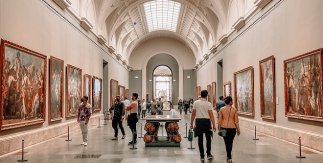
From its privileged residence surrounded by trees and some of Madrid´s greatest monuments, the National Museum of the Prado is one of the most visited attractions in the capital. Together with Velázquez's Meninas and The Shootings of May 3rd, 1808, by Goya, the museum displays masterpieces from Spanish, Flemish and Italian schools.

History

It was in 1785 that the foundations for the new Cabinet of Natural History were first laid. The building had been commissioned by Carlos III, one of Madrid’s great public works innovators and city benefactor.Juan de Villanueva was given the task of overseeing the design and construction. The building is based on two elongated wings each finished off by cubic structures, with a symmetry-reinforcing structure shaped like a basilica separating both sides. Despite this royal foresight, it was actually another king, Fernando VII, who ordered the royal painting collection to be housed there. The monarch took over the final works that had been commenced in the previous reign but brought to a standstill during the upheavals of Spain’s War of Independence while occupied by French troops.

During his reign, with the active interest of his wife Maria Isabel de Braganza extending vital support, the museum was finally inaugurated on November 19th 1819 and originally contained approximately 300 works of art.

The current collection of art work that is kept in the Institution was gradually enlarged over the years, mostly thanks to contributions from the royal collection. The first such transfer was that of some 1,500 works, donated by Felipe V. After his death, Isabel II bought out her sister’s share of the inheritance, so as to keep the collection intact, which became the principal reason for which these works remain associated with the crown.

In 1872, four years after the collection’s nationalisation and after having been baptised Museo Nacional del Prado, arrived the largest single contribution: nearly three thousand works that originally had been part of the collection at the Museo de la Trinidad. This outstanding number of pieces, which the Villanueva building couldn’t possibly all contain, was lent out among different institutions and museums. All told, it was nearly four thousand works of whose renown led to its being named the ‘Extended Prado’.

It is worth pointing out the historical centenary celebration of the museum, a party which went sour after the concomitant theft of eleven chalices from the Tesoro del Delfín (The treasure of the Dauphin), a precious set of dishes inherited by Felipe V, the first of the Bourbon Dynasty, and which were subsequently damaged. Another dark page came with the onset of the Civil War, during which time many of the art works had to be stored on the first floor, protected by piles of sandbags against the bombardment of the city. The League of Nations recommended taking the art away from the beleaguered city, and transporting them truck by truck, to Geneva. World War II soon triggered the early return of the collection to Madrid.

Following the war, the museum once again became a public venue and, once more opening wide its doors, saw a dramatic increase in the number of visitors now coming as tourists, a trend that has continued and grown ever since. 

Enlargement of the Prado

Latest extension of the Prado by MoneoThe dearness of available space at the museum precipitated a series of enlargement works over the 20th century. The first one took place in 1918 affecting the rear side of the building, opening successive patio spaces which were later covered over. Furthermore, the enlargement undertaken over the 50s and 60s filled up the remaining terrain to the museum’s rear.

The lack of available space was finally dealt with comprehensively with the building of an annex in 1971, which was added to an older, independent structure called the Cason del Buen Retiro. The latter had been built in 1637 by the architect Alonso de Carbonell to house the ballroom of one of Felipe IV’s leisure palaces, of which the painted ceiling remains today, painted by Lucas Jordan in the 17th century.

Despite these various additions, the Prado Museum only exhibits a part of its overall collection. For this very reason, another enlargement project by architect Rafael Moneo has just been inaugurated. It consists of a new building nearby the old cloister edifice of the Jeronimo brotherhood, and which is connected to the present traditional space (Villanueva) by a spacious low lying structure.

In this way there will be additional space for temporary exhibits, restoration workshops, an auditorium, a cafeteria, a restaurant and offices. On the other hand, the real innovation really lies in the reforms undergone by the Villanueva building, housing both the historical collection as well as the modern ones.

Great Works of Art

The Prado Museum has increased its reserves throughout its history, reaching today’s record number of 8,600 paintings and 700 sculptures, of which only about a seventh are ever exhibited at any given time. Besides being one of the most important collections of 16th and 17th century paintings, boasting names such as Hieronymus Bosch, Titian, El Greco, Murillo, Rubens, Goya and Velazquez, the museum has additional collections of decorative pieces, drawings and engravings, which are not less valuable for being lesser known works.

The sheer volume of Spanish paintings is what makes the Prado so invaluable compared to other painting collections. Its halls display an impressive range of works, from Romanesque murals from the 12th century to Francisco Goya’s contributions to early 19th century art. These rooms, located from the ground level to the second level, have canvases by El Greco as well, notably Portrait of a Nobleman With His Hand on His Chest (El caballero de la mano al pecho) and The Adoration of the Shepherds (La adoración de los pastores).

Prado MuseumAppreciators and lovers of art will certainly know to what measure the should value the paintings from Spain’s Golden Age at the museum, especially the more than forty painted by Diego Velazquez, among which are his famous Las Meninas, located in a specially large room, along with The Fable of Arachne (Las hilanderas) and the Adoration of the Kings (La adoración de los Reyes).

Another must-see is the room dedicated to Goya’s paintings, set on the main floor as well as the second level. The itinerary of his artwork goes from some tracings which were made by the painter for the Tapestry Works, such as El Quitasol, to his black series paintings Saturn Devouring His Children, along with such well known works as Carlos IV and his Family, and The Maja series, one nude and the other attired.

Other Collections

The Prado Museum stands apart, as much for the quality of its exhibits as the variety of painters and paintings in its collection. Its walls are hung with canvases from France, and Italy, with ample room for the Flemish and German Masters. Some paintings date back to the early Renaissance, conspicuous among which are Boticelli and Fra Angelico, while others follow the artistic path up until the 18th century, with the museum dedicating a total of 16 rooms to Italian painting alone. There is a special focus on the Venetian School, in which the visitor may enjoy such painters as Rafael, Tician, Tintoretto, Bassano and Verones.

On the ground floor there is a very interesting collection of Flemish paintings, with works by Rogier Van der Leiden, Dirk Bouts, Hans Memling, Bosch, and other names from the 16th century. Among the Flemish artists of the 17th century there are works by Rubens, Van Dyck and Brueghel. One of the most revealing works of this age is The Three Graces, by Peter Paul Rubens.

Contrasting with this extraordinary number of Flemish paintings is a smaller section devoted to Germany, with works dating between 1450 and 1800, eventhough their quality makes up for their reduced number. Among these are works by Albert Dürer, Lucas Cranach and Baldung Grien, whose paintings are located on the ground level, while the painter Anton Rafael Mengs may be found on the second level.

Finally there are works by Poussin, Claude Lorrain, Van Loo and Watteau which are the choice works among a French collection that was acquired thanks to the donations made by Felipe IV and Felipe V, who forged special ties with France throughout the 17th century.

Although the Prado Museum is known the world over for its painting collection, its sculptures are very much a part of its exhibition. Composed of over 200 classical figures, it contains fine examples of archaic- period Greek sculptures up to the Hellenic period, and further on, the Roman era. There are also works by Leoni which originated as commissions by the kings Carlos V and Felipe II in the 17th century.

In addition to sculpture, the Prado also houses a collection of decorative pieces. Although not all of this collection is put on display, the tables, ceramic pieces and dishes which compose this collection are distributed throughout the exhibition space of the permanent collection. Outstanding among them is the Treasure of the Dauphin, while yet another facet of this precious collection are the drawings, of which there are over four thousand, the most famous being the drawings and engravings by Goya.

Latest Restorations

Since April 2006, the Prado Museum has recovered three important religious-themed canvasses in the spirit of enriching the holdings of its permanent collection. La Crucifixión (The Crucifixion), a masterpiece from the Hispano-Franco Renaissance and from artist Juan de Flandes, is situated in the privileged location of room 49, where it is being displayed after a restoration process that has been undertaken in the museum’s workshops and has returned all the splendour to the piece.

The public will also be able to enjoy the return of one of El Greco’s most significant pieces, La Adoración de los pastores (The Adoration of the Shepherds), which has not been exhibited since June 2004, as it had to undergo meticulous restoration.

Finally, the installation of San Jerónimo (Saint-Jérôme) by Georges de la Tour in room 5 completes the range of works that have been added to increase interest for visitors to the museum.

Prado MuseumInside the Prado MuseumPrado Museum Las Meninas, by Velázquez (detailed review)

USEFUL INFORMATION

Prado Museum
Paseo del Prado, s/n

Metro stations: Banco de España (Line 2) and Atocha (Line 1)
Buses: 9, 10, 14, 19, 27, 34, 37 and 45
Train: Atocha
Phone numbers: (+34) 91 330 28 00
Opening hours:

  • Tuesday to Sunday, 9am to 8pm. Closed on Monday (including public holiday).
  • December 24, December 31 and January 6, 9am-2pm.
  • Last admission 30 minutes before closing time. Galleries emptied 10 minutes before closing time.

Prices (Permanent Collection)

  • General price: 8 € at ticket office; 7€ advance sales by internet.
  • Reduced price: 4 € at ticket office; 3.5€ advance sales by internet. For:
    - EU citizens with Large Family accreditation
    - Students from non-EU countries aged under 25
    - Young People's card holders
    - Members of cultural parties of 15 or more members with prior permission from the Director
  • Free entrance:
    - Tuesday to Saturday, 6 pm-8 pm and Sundays, 5 pm - 8 pm. 
    - May 2 (Official Day, Region of Madrid), May 18 (International Museums Day), October 12 (Hispanidad Day), November 19 (Prado's Anniversary) and December 6(Constitution Day).
  • Free entrance with proof of status to:
    - Visitors aged under 18
    - Visitors aged over 65 or retired or permanently disabled from EU countries
    - Unemployed visitors from EU countries
    - Students from EU countries aged under 25
    - Staff of Spanish State Museums run by the Ministry of Culture
    - National and local tourist guides
    - Teachers whose subjects are directly related to the contents of the Museum and who are engaged in teaching during the visit
    - Members of:
    FAMP (Fundación Amigos del Museo del Prado)
    APEME (Asociación Profesional de Museólogos de España)
    ANABAD (Asociación Nacional de Archiveros, Bibliotecarios y Museólogos)
    AEM (Asociación Española de Museólogos)
    ICOM (International Council of Museums)
  • Paseo del Arte's Pass: 14,40 €. Available at Goya's point of sales; allows to visit the Prado, the Thyssen-Bornemisza and the Reina Sofía museums.

Prices (Temporary Exhibtion):

  • The price will be set by the Director of the Museum if admission is not included in the ticket for general admission to the Museum. Check here.

Bookings and telesales:

  • Visitor Centre (+34)  902 10 70 77
  • Internet

Prado Museum official website

Exhibitions and activities at the Prado


RELATED LINKS